
If you have ever tried your luck on the Eye of Horus slot, you have already experienced among the most iconic payline configurations in online gaming https://eyeofhorus.games/. That one screen of ancient Egyptian symbols hides a deceptively simple system that determines every win you receive. I want to take you through the exact way slot paylines operate, using Eye of Horus as our working example, because when you understand paylines, you will never see a slot the same way again. A payline is more than a line across the screen; it is the set of rules that determines whether matching symbols turn into a payout. In Eye of Horus, you are always playing with 10 fixed paylines that run from left to right, and that fixed nature shapes everything from your bet size to how bonus features explode into life. Let us go through what paylines are, how they create wins, why fixed lines are significant, and how they interact with wilds and free spins, all while maintaining the focus firmly on the game you are here to master.
How Paylines Shape Your Bet Size
Your total bet per spin in Eye of Horus is a direct multiplication of the coin value you select and the number of paylines, which is always 10. If you set the coin value to 0.05, your total stake becomes 0.50; push it to 1.00, and you are spinning for 10.00. This transparent relationship makes bankroll management straightforward because you always know exactly how much each spin costs and how that cost divides across the 10 lines. I often use this to fine‑tune my session. When I want to extend playtime, I drop the coin value to the minimum of 0.01, giving me 0.10 spins that still engage every payline. When I am chasing the free spins feature and feeling more aggressive, I raise the coin value, but I never have to worry that I am accidentally betting unevenly across lines. The fixed structure ensures that my risk per line stays perfectly proportional, which is a huge mental relief.
Because all 10 lines are always active, the cost of covering the entire grid never changes relative to the coin value. This has an important psychological effect: you never feel like you are missing out on a potential win because you skimped on lines. Every symbol that lands on the screen is being evaluated against all possible payline paths, so the excitement level stays high. The bet range in Eye of Horus runs from 0.10 up to 100.00 per spin, which accommodates both cautious players and high rollers while keeping the payline math identical at every level. I always remind myself that the return to player percentage does not shift based on bet size, so whether I am spinning at 0.20 or 20.00, the 10 paylines are working with the same underlying probabilities. That consistency is one of the reasons this game has remained so popular across different types of players.
Fixed Paylines Versus Variable Paylines
Slot developers have to choose early on whether to offer adjustable paylines or keep them fixed. Eye of Horus is firmly in the fixed‑payline camp. In an adjustable‑payline slot, you can choose to activate only a subset of the available lines, which reduces your total bet but also diminishes your probability of hitting a win on any given spin. Eye of Horus removes that option: all 10 lines are always on, and your bet slider just scales the coin value across those 10 lines. I favor this approach because it erases the risk of accidentally playing too few lines and missing a scatter‑triggered feature or a high‑value wild combination that lands on an inactive path. With fixed paylines, you never have to second‑guess whether you are playing optimally; the game is balanced around the assumption that every line is live, and the math model, including the 96.31% RTP, is calculated with that full coverage in mind.
The trade‑off with fixed paylines is that your minimum spin cost is higher than it would be on an adjustable game where you could activate just a single line. In Eye of Horus, the lowest possible total bet is 0.10, which translates to 0.01 per line. That is still very accessible, but it means you are always pledging to all 10 lines. For me, this is a fair exchange because it assures that I am never watching a big win land on a line I forgot to activate. Plenty of modern slots have joined Eye of Horus down this fixed‑payline path because it simplifies the player experience and ensures that every feature trigger, every wild expansion, and every scatter pay is fully available on every spin. When you sit down to play, you can concentrate entirely on the Egyptian atmosphere and the rhythm of the reels rather than messing with line selectors.
How to Understand a Payline Table and Play More Strategically
Every slot, including Eye of Horus, features a paytable that details the exact payouts for each symbol across the active paylines, and getting the hang of it fast will boost your strategy. Check the information screen and you will see a grid presenting coin wins for three, four, and five matching symbols. The values are usually displayed as a multiple of your bet per line, so if the Pharaoh shows 100 coins for five of a kind and your line bet is 0.01, that win is 1.00. I make it a point to checking the paytable before I start spinning because it reveals which symbols are the high‑value targets and which are merely filler. In Eye of Horus, the wild is the top payer, then comes the Pharaoh and the scarab, while the card royals provide smaller, more frequent hits that maintain your balance. Recognizing this hierarchy enables me to stay patient during dry spells, because I understand that the big line wins come from the premium symbols, and they are worth holding out for.
With fixed paylines, your strategic focus shifts entirely to wagering strategy and time planning rather than payline choice. I always determine a session budget and split it by my chosen total bet to see how many spins I can manage. With 10 lines always active, even a modest bankroll of 50.00 gives you 500 spins at the minimum 0.10 stake, which is more than enough for the free spins feature to appear. I also monitor the gamble feature, which can multiply line wins, but I apply it selectively because it operates outside the payline system and carries its own downside. When the expanding symbol free spins trigger, I observe the paylines closely, mentally tracing the paths to see how many lines the expanded reel is supplying. This active engagement transforms the game from a passive spin‑and‑hope experience into a more thoughtful session where I understand exactly why my balance is changing. The 10 paylines of Eye of Horus are not just a minor aspect; they are the essence of the game, and once you understand their rhythm, every spin becomes a little more enjoyable.
- Always check the paytable prior to playing so you understand symbol values and payline patterns.
- Keep in mind that all 10 paylines are fixed, so your total bet is always coin value multiplied by 10.
- Scatter icons pay anywhere on the screen and do not need to land on a payline.
- Growing symbols during free spins can complete wins on multiple paylines at once.
- Wilds stand in for all regular icons and generate the highest single‑line payouts.
What Exactly Is a Slot Payline?
A slot payline represents a predetermined path across the reels that the game employs to check for matching symbols. When you hit spin, the game looks at each active payline, commencing from the leftmost reel, and checks whether identical symbols have appeared on adjacent reels along that specific line. In Eye of Horus, there are 10 such paths, and they are all permanently active. That means every single spin assesses all 10 patterns, so you never have to choose how many lines to play. The classic payline concept dates back to the earliest mechanical fruit machines, where a single horizontal line across the center was the only way to win. Modern video slots like Eye of Horus keep that DNA but expand it into zigzag, V‑shaped, and diagonal arrangements that cover the 5×3 grid in clever ways. View the paytable in Eye of Horus, and you will see exactly which symbol combinations https://www.cbc.ca/sports/soccer/worldcup/opinion-women-world-cup-brazil-marta-aug2-shireen-ahmed-1.6925291 award on these 10 lines, and the game illuminates winning lines with a brief animation so you never have to guess. This transparency is what makes payline slots so rewarding: you always recognize the rules, and every spin gives you 10 independent chances to land a sequence of matching icons.
The left‑to‑right rule is the key that enables every payline slot. In Eye of Horus, a winning combination must commence on the first reel and proceed along the line without gaps. If you land three Pharaoh symbols on reels one, two, and three along payline one, you win; if those same symbols show up on reels two, three, and en.as.com four but skip reel one, that line pays nothing. This directional requirement is why the first reel often seems so important. I always give close attention to what lands on that leftmost reel because it dictates whether any payline can even begin a winning sequence. Scatter symbols are the famous exception, and in Eye of Horus the golden temple scatter awards anywhere on the reels regardless of paylines, which I will cover later. For now, just keep in mind that a payline is a defined, unbroken trail that the game traces across the grid, and in this Egyptian adventure you are always dealing with exactly 10 of them on every spin.
Winning Lines Versus Methods to Win and Additional Mechanics
Eye of Horus sticks to a standard 10‑payline format, but the slot world is packed with various systems, and knowing the difference will help you become a more well-rounded player. Ways‑to‑win slots, like those with 243 or 1,024 ways, remove separate paylines completely and in their place reward for matching symbols on neighboring reels beginning from the left, no matter their perpendicular position. In that system, any symbol on reel one can combine with each symbol on reel two, and the count of winning ways increases rapidly. Megaways slots push this even farther with a dynamic reel height that alters on every spin. Cluster pays slots, on the other hand, need groups of connecting symbols rather than line‑based sequences. All of these mechanics has its own flow, but I continually return to payline slots like Eye of Horus because they offer a simplicity that more intricate systems at times lack.
Traditional paylines continue to be well-liked for a few causes, and Eye of Horus represents all of them. Paylines give you a fixed, foreseeable number of possibilities per spin, which renders bankroll computations straightforward. The visual feedback of viewing a particular line highlight builds a direct link between the symbols on the screen and the win you simply earned. Payline slots also pair wonderfully with expanding wilds and stacked symbols because those features can occupy entire lines in a way that appears purposeful and earned. I also appreciate that payline games have a tendency to have clearly defined symbol values, so you can peek at the paytable and immediately understand what a entire line of Pharaohs is worth. While I take pleasure in testing Megaways and cluster pays, when I desire a session that harmonizes old vibe with rock‑solid mechanics, I load Eye of Horus and let those 10 lines do precisely what they were intended to do.
Payline mechanics and Bonus Features in Eye of Horus
Bonus features are where paylines really show their potential, and Eye of Horus has one of the most satisfying connections between free spins and line wins I have encountered. The mechanic kicks in when three golden temple scatter symbols appear anywhere on the reels, and because scatters pay regardless of paylines, you do not need them to line up on a certain path. Once inside the free spins, a unique expanding symbol is arbitrarily selected from the high‑paying icons. Whenever that symbol shows up during the bonus round, it grows to occupy the entire reel, and this is where the 10 paylines become extremely efficient. An expanded reel occupies every row on that column, which means it at the same time completes winning combinations on various paylines at once. If the expanding symbol appears on the first reel, it can start wins on all 10 lines in a one spin, given the matching symbols proceed along the reels.
The wild symbol in Eye of Horus, represented by the game’s logo, also performs a crucial payline role during both the base game and free spins. It replaces for all regular symbols except the scatter, and because it is the highest‑value icon, hitting a cluster of wilds on a payline produces the biggest single‑line payout. During free spins, the wild can appear alongside the expanding symbol, and when that happens, the payline assessment becomes a cascade of overlapping wins. I have seen spins where an expanded Pharaoh symbol on reel two and a wild on reel three produce wins across seven or 8 various lines at the same time, each one computed separately and added to the total. This is the moment when understanding paylines shifts from theory to pure adrenaline, because you can truly watch the game trace each line and pile up the payouts. The 10 fixed lines guarantee that no part of the expanded reel is wasted, and that full‑grid coverage is what turns the bonus round able of giving the game’s maximum win of up to 500 times your total stake.

The way Paylines Build Winning Combinations
Any symbol in Eye of Horus bears a value, but that value only turns into a win when the symbols stop on an active payline in the right sequence. The paytable displays the coin payouts for three, four, or five matching symbols on a line, and those numbers rise steeply as you get more symbols. For example, the Eye of Horus wild symbol is the highest payer; landing five of them on a payline delivers the top line hit. Below that, the Pharaoh, the scarab beetle, and the classic card royals complete the hierarchy. I view each payline as its own little mini‑game playing at the same time. On a single spin, payline one might deliver a small win with three Aces, while payline seven activates with four Ankh crosses, and the game adds those payouts together before displaying your total win. Because Eye of Horus uses 10 fixed lines, you are always managing 10 separate opportunities, which is why even a modest spin can suddenly generate a chain of multiple line hits that appear much bigger than the individual amounts.
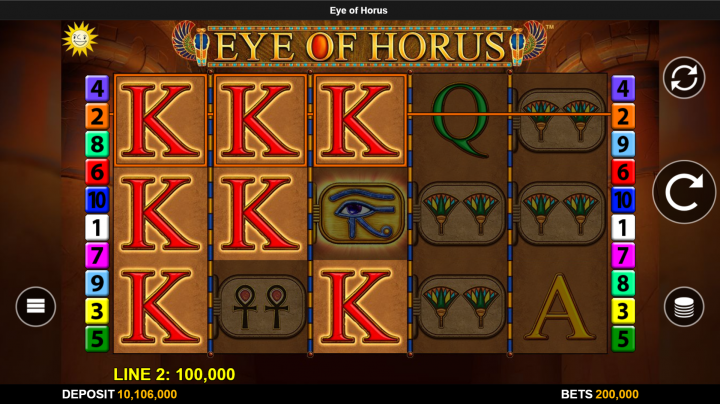
The actual layout of those 10 lines is more important than most players recognize. In Eye of Horus, the lines are not just horizontal stripes; they feature patterns that drop and rise across the three rows. Some lines span the top row on the first reel, fall to the middle on the second, and climb again on the third. This weaving design implies that a symbol landing in a corner position can still be part of a win if it sits on one of the less obvious paths. I always suggest opening the game’s payline information screen at least once, because observing the numbered lines overlaid on the reels removes any mystery. When you then watch a winning spin, you will observe that the same symbol can apply to multiple paylines simultaneously if it is positioned at an intersection point. That is how Eye of Horus can deliver those moments where the screen looks like it erupts with highlighted lines, and your balance increases in a satisfying cascade of small and medium wins all triggered by a few well‑placed icons.